“This Isn’t Bunco!”—Real Talk from Mah Jongg Teacher, Sylvia
The Mah Jongg Bug: How Sylvia caught It and spread it. Why Mah Jongg is more than just a game.
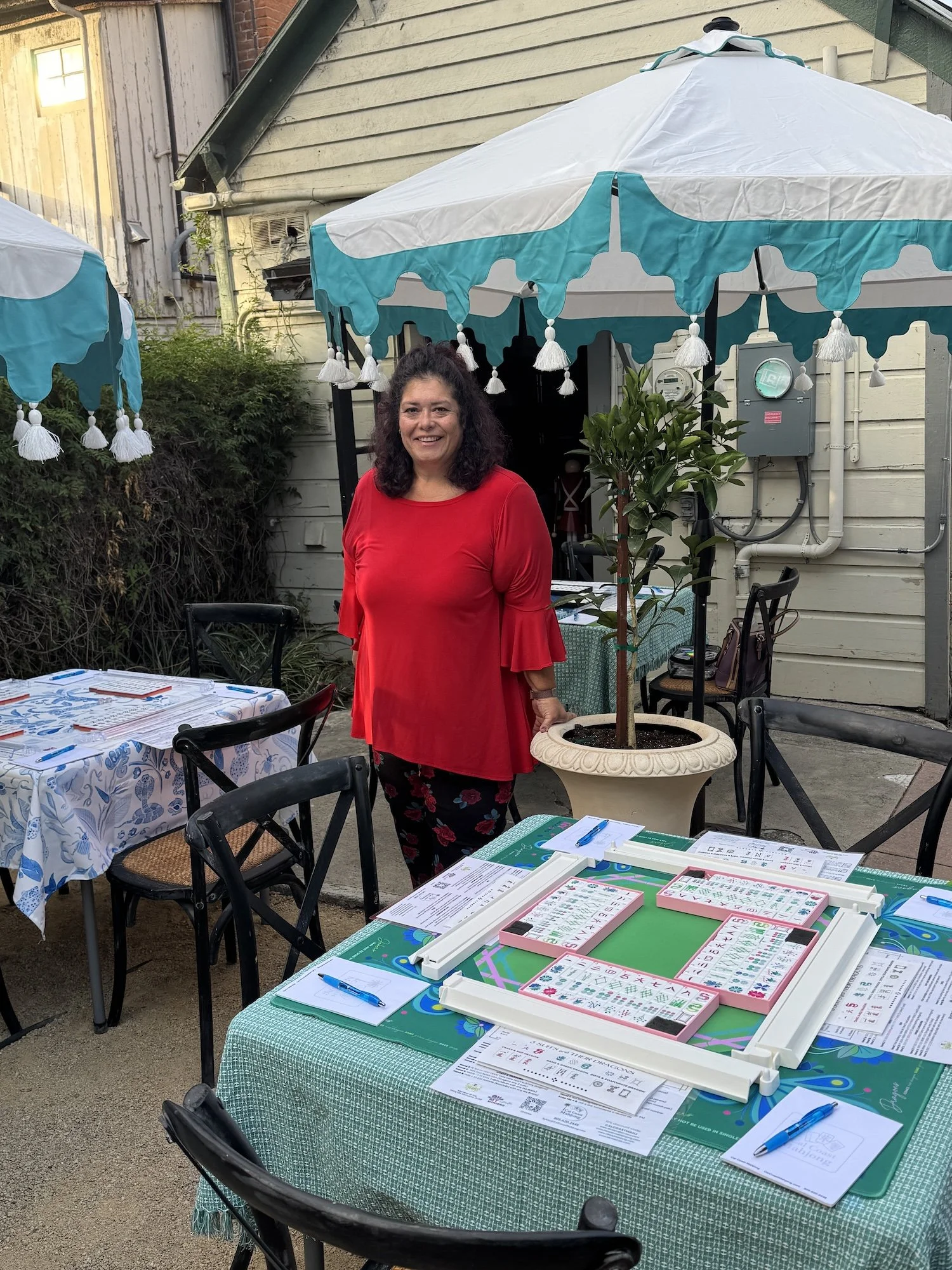
For my second post this month I am continuing in my series of interviews with Mah Jongg teachers across the country. Here is a fun interview with a popular and successful Mahj teacher based in California. I am sure you will smile and nod along with many of Sylvia’s answers. But hopefully you will also glean some new ideas as a player (or as a teacher) that will be little gems to carry with you on your own Mahj journey. It was a joy for me to learn about Sylvia’s journey. Let me introduce you to her now.
Stacey: Thanks for agreeing to be interviewed for my blog, Sylvia. Let’s begin with the basics. Can you tell me how long you've been playing American Mah Jongg? And how long have you been teaching others how to play?
Sylvia: I took Mahjong lessons with a group of ladies 2.5 years ago. We quickly realized that we needed to play regularly to remember all the rules and sharpen strategy skills while playing. We've been playing weekly ever since! I have had so much fun playing that I eventually taught my husband, two sons in their early twenties, and my older son's girlfriend. Now I look forward to our family dinner and game nights. As my passion for playing grew, seeing the enjoyment in family game times together, and having free time while I was in-between jobs, I decided to start teaching Mahjong as a side-hustle. I've been teaching for about a year now, and it's so much fun to watch groups go from complete bewilderment of all the tiles, rules and how to read the NMJL card - to the excitement of building their first winning Mahjong hand!
Stacey: What motivated you to learn how to play, and can you talk a little bit about that experience?
Sylvia: I have seen Mahjong referenced in movies, but I had never seen anyone play the game in real life. A friend reached out to see if anyone was interested in learning and I thought it would be great to learn something new and social. As my kids were out of high school and doing their own thing, I thought this would be a fun thing for me to learn, for me. Our family had always enjoyed playing games together, so this was an opportunity for me to learn a new game. When I took lessons, I kept notes in an app on my phone. There was so much to learn and remember! Occasionally, I go back and look at my notes to see what I wrote, and what I thought was most important to write down. I get a laugh out of those notes. But it also helps me remember what my students are feeling, as I'm teaching.
Stacey: What a great way to help you remember what it was like as a newbie yourself so you can keep that in the back of your mind as you plan your lessons. Now, will you say a little bit about your experience as a teacher of MJ? For example, do you have certain teaching methods and tools that you have found work best with newbies to the game?
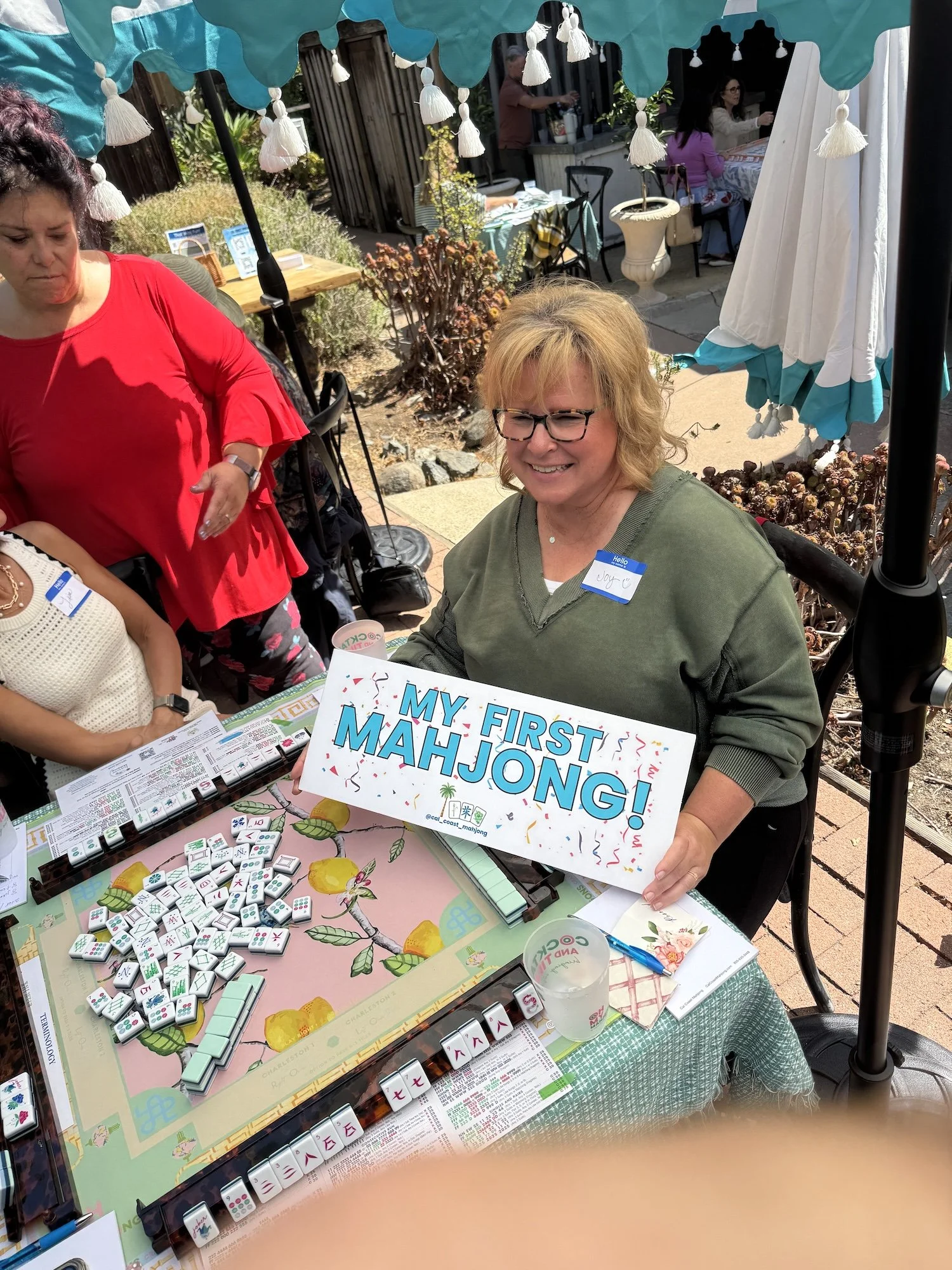
Sylvia: I have found Michelle Frizzell's Mahj Life Guild extremely helpful and a wealth of knowledge! There are many tips and tools of hers that I have incorporated into my teaching lessons. I prefer to break up my teaching into (2) 2.5-hour lessons to make sure most rules and game play are covered. I want my students to be able to sit down and play a full game when they complete two lessons. I'm a believer that the biggest hurdle is decoding how to read the NMJL playing card. This is where I spend a big focus on the first lesson - between learning the tiles, learning singles, pairs, pungs, kongs and quints, and how to decipher the winning hand patterns. By the end of my first lesson, I've had them build several practice hands and we play a game or two of "messy Mahjong" with one round of the Charleston, so they get the concept of building a hand based on the card, and game flow of drawing and discarding. In my second lesson I introduce building the walls, completing the full Charleston, and game flow with etiquette. They can play on their own at the end of this lesson. Some groups have asked me to come back for guided game play and more strategy offerings.
Stacey: What do you find is the most rewarding aspect of playing Mah Jongg? And the flipside, what do you find most challenging for you as a teacher of MJ?
Sylvia: I love the strategy of the game, and with some luck, yelling "Mahjong!". I also find it rewarding to spend quality time with family and friends in a (mostly) distraction free environment. There are many studies showing games like Mahjong are good for cognitive health, so there’s that bonus benefit! And same question, but for teaching the game. Seeing my students go from a "deer in the headlights" look to the light bulb "ah-ha" moment, when they grasp a concept of game play. And of course, the excitement when they make their first Mahjong. Also, seeing the enthusiasm at the end of the lesson when they start discussing when they're going to meet again for their next game. Seeing them get hooked like that is what it's all about.
I recently taught a group of 8-12 year-olds, and they had so much fun. The 8 year-old cried when we told him time was up – he didn’t want to leave until he made his first Mahjong! I can’t wait to start teaching more kids, as I’m all for any good activity that keeps them off their digital screens.
I find the most challenging times are when student groups use the lesson time as their social catch-up time, and chat while I'm trying to teach. You can see how it affects other students who are truly trying to grasp the concept and want to learn. I usually start off by saying "This isn't Bunco. You have to listen, watch and think."
Stacey: That happens to me occasionally when I teach a group of people who are good friends. Some don’t realize that talking to the player next to them while I am sharing vital information can make it more difficult for others to stay focused. I usually just stop talking and look at them and smile, then politely ask if they would please hold side conversations until later, or if they have a question, I ask them to share with the whole group because others might have the same question. So , I agree with you, it can be a challenge wrangling newbies who love to be social. Next question: How do your students find you?
Sylvia: I have a website www.CalCoastMahjong.com, a Facebook page by the same name, and an Instagram account @cal_coast_mahjong. I'm also listed as a teacher on the Oh My Mahjong website, the American Mahjong Association website and Mahj Life website. I teach in Ventura, Santa Barbara and San Luis Obispo counties, which comprise the Central Coast of California, hence Cal Coast Mahjong.
Stacey: I took a peek at your website and I am very impressed! First off, I appreciate the larger font size. As we age, our vision can tend to be less sharp, so thank you for not making me get out my readers…lol. I especially like the photos you have posted of some of the groups you have taught, and of yourself in your “About” page. And the testimonials are really heart-warming. Lots of helpful links on your “Deals & Discounts” page too. You cover a wide geographical area. Since Mah Jongg’s popularity has been spreading like wildfire these days, I am thinking that at some point you may have to hire a small army of fellow MJ teachers in your area to help you serve all the clients who are going to be wanting lessons! Moving on, will you describe the typical number of lessons your students take with you, and if you do one-on-one or small or larger groups at one time?
Sylvia: I recommend 2 lessons when people inquire. Right now, I'm mostly doing private groups between 8-16 people. I have done lessons for larger groups at a country club and gift shop. Some groups choose to do a Bootcamp class – both lessons in one day. We'll go for about 2.5 hours, take an hour break for lunch then complete the second 2.5-hour lesson. That format works out well, because they are ready to play on their own by the end of the day! And do you charge? Yes, I charge. I'm providing a knowledgeable service, complete with lesson prep and post lesson handouts. And I make myself available to students, post lessons, if any questions come up while they are playing in the future.
Stacey: I’d like to ask you about my Flipbook now. Do you have any feedback for me?
Sylvia:I offer your book after my beginner lessons. It’s a great reference guide the students find helpful to review and have in hand since so much info is thrown at them all at once. I really like that it’s easy to find a specific aspect of the game, where they can reference back to what they’ve learned. I really like your “Tips from Seasoned Players” section!
Stacey: Thanks for your positive feedback, Sylvia. I am glad you find my Flipbook a useful teaching tool Moving on . . Do you have any experience playing Asian versions of Mah Jongg? If so, can you tell me which ones and how they compare with the NMJL's version of American Mah Jongg?
Sylvia:Two of my weekly playing buddies grew up playing Filipino Mahjong, which I believe is a close variation of Hong Kong Mahjong. They have taught our group how to play, and we'll throw in a Filipino night occasionally. It's definitely easier, given the fact you don't need a playing card to determine winning hands, and it's a fun change of pace occasionally.
Stacey: Are you familiar with Siamese MJ? How about Royal Siamese MJ? If so, how do you like playing that way? (If not, I recommend checking it out! I have a QR code in the 3rd edition of the Flipbook that takes you to the website for more info.)
Sylvia:I play Siamese Mahjong with my husband when it's just the two of us. I enjoy it because it's an added level of challenge, since you're playing two hands. I also feel it helps you learn the NMJL card quicker, because you’re playing more hands, you just have to remember not to play two lines that are competing for the same tiles! It's also fun that you can move tiles between your hands/racks as you're building winning hands. We just use the NMJL playing card when we play Siamese. I have not played Royal Siamese Mahjong, so I had to read up on it, and that sounds like a lot of fun too! I’m going to see if I can get the family to give that a try.
Stacey: Do you ever play for money? If so, how do you feel about playing that way?
Sylvia:My weekly group doesn't want to incorporate money or scorekeeping. BUT, I recently found a group at a local center that does play for money, which has been a lot of fun. I really feel it elevates your game and strategy because there’s money on the line. Just today, I came home with $4 less in my pocket, yet yesterday when I wasn’t playing for money, I had 5 Mahjongs and 2 of them were Singles & Pairs. It’s all about timing, I guess.
Stacey: Sometimes luck is with you, and sometimes it’s not, right?Have you attended or run any MJ tournaments? If so, will you say more about those experiences?
Sylvia:I have not, but my goal for 2026 is to attend my first tournament.
Stacey: What advice do you have for experienced players who are thinking of becoming MJ teachers?
Sylvia:Join Michele Frizzell's Mahj Life Instructors Guild! It's the best investment to help you plan your teaching practice. Make sure you have a structured lesson plan, and practice a few times with friends, so that you get your lesson plan figured out and know what works and doesn't work.
Stacey: What else would you like to say about your experience as a player or as a teacher of Mah Jongg that you think would be interesting, entertaining or educational to my readers?
Sylvia:My experience has been totally positive, both learning and playing, and now also teaching. I love that it's a "universal game" when following the NMJL rules; that you can meet up with other players anywhere and jump right in to playing. Last Fall my husband and I took a 16-night cruise, and we joined a cruise-specific Facebook group before our trip. I posted asking anyone who plays American Mahjong, to bring their NMJL playing card and let's meet up. We ended up with a group of eight, that got together every sea-day and played for 2-3 hours. It was a blast to meet people from all over the USA, and be able to just sit down and start playing. I recently went to a weekly, local open-play and met some nice ladies while playing. It opens up opportunities to meet people I would not have crossed paths with otherwise.
Stacey: Sylvia, thanks for taking the time to share a bit of yourself with my readers and me. I am sure everyone will enjoy reading your Mah Jongg origin story, and for those based in the Central CA coastal area, there is now a great local Mah Jongg resource!