
How to Find Your Mah Jongg Teaching Comfort Zone: Advice from Orlando, Florida’s MJ Pro, Diane
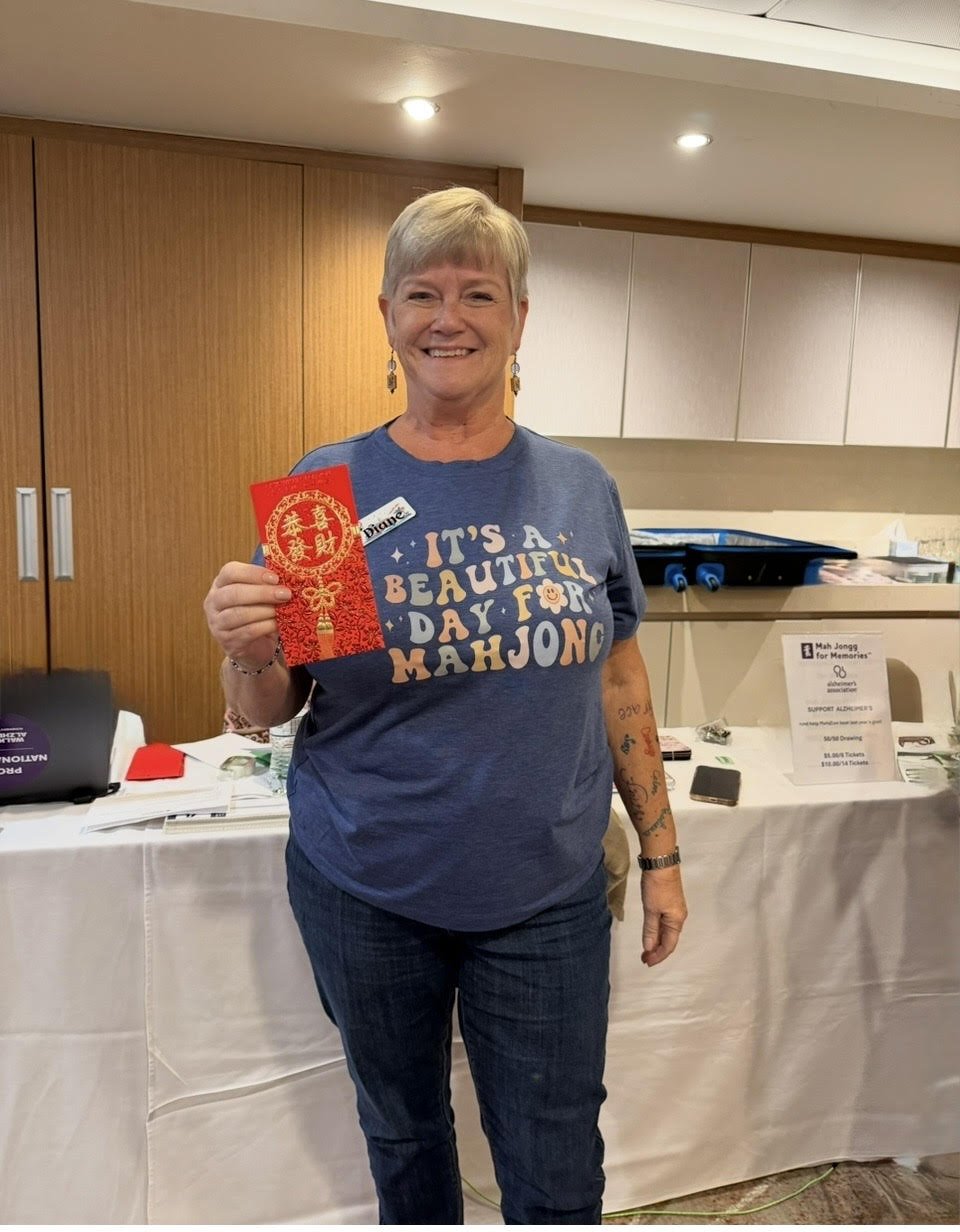
Diane, A Proud MJ Award Winner
Have you ever thought about taking your love for the tiles to the next level? Today, we are sitting down with Diane, a seasoned Mah Jongg instructor making waves in Volusia County, Florida. Whether you are an experienced player looking to transition into teaching or a student looking for a masterclass in table etiquette, Diane has a wealth of wisdom to share. From finding your personal teaching comfort zone to navigating student dropouts without taking it personally, she is sharing her roadmap for building a fluid, successful classroom. Pull up a chair and learn how to perfect your own personal style—both on and off the board!
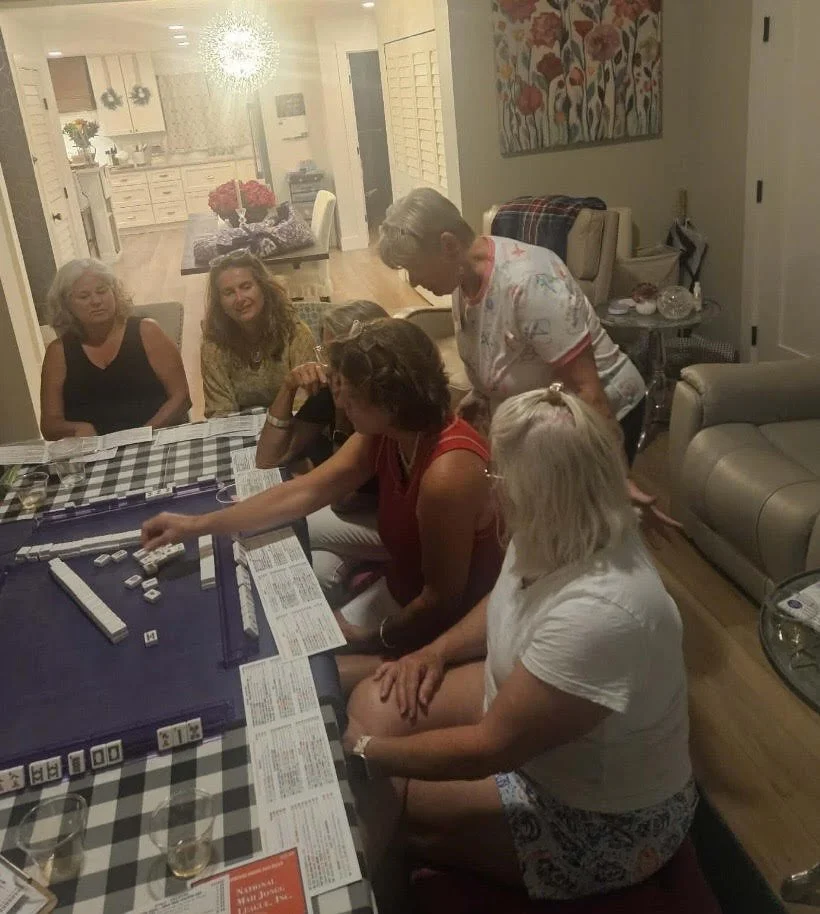
Diane in Teaching Mode
Stacey: We "met" on Facebook about a year ago when you kindly posted a photo of my (then) second edition of the Flipbook, and folks went crazy! I had the busiest sales day to date with a total of 169 books sold on that day! I am so grateful that you continue to promote my Flipbook on social media, especially because you genuinely appreciate how helpful it is as a teaching tool. So, it is my great pleasure to introduce you to my blog audience. I'd like to start with a geographic question. In which part of Florida are you located?
Diane: I live in Ormond Beach FL, moved to this area in November 2022. Before FL I lived in DuPage County IL (Chicago Suburbs), born and raised.
Stacey: Can you tell us how long you've been playing American Mah Jongg? And how long have you been teaching others how to play?
Diane: I learned American Mahjong in the early 90s. Life became busy, friendships changed and I did not continue playing for many years. Fast forward retirement in FL November 2022 I began playing several times a week in my HOA club/clubhouse. I moved after 2 years and still play with the club ladies as a guest. At that time, I searched online and found 3 other organized opportunities. I currently play 5 sessions per week and sometimes pickup games. It’s my passion.
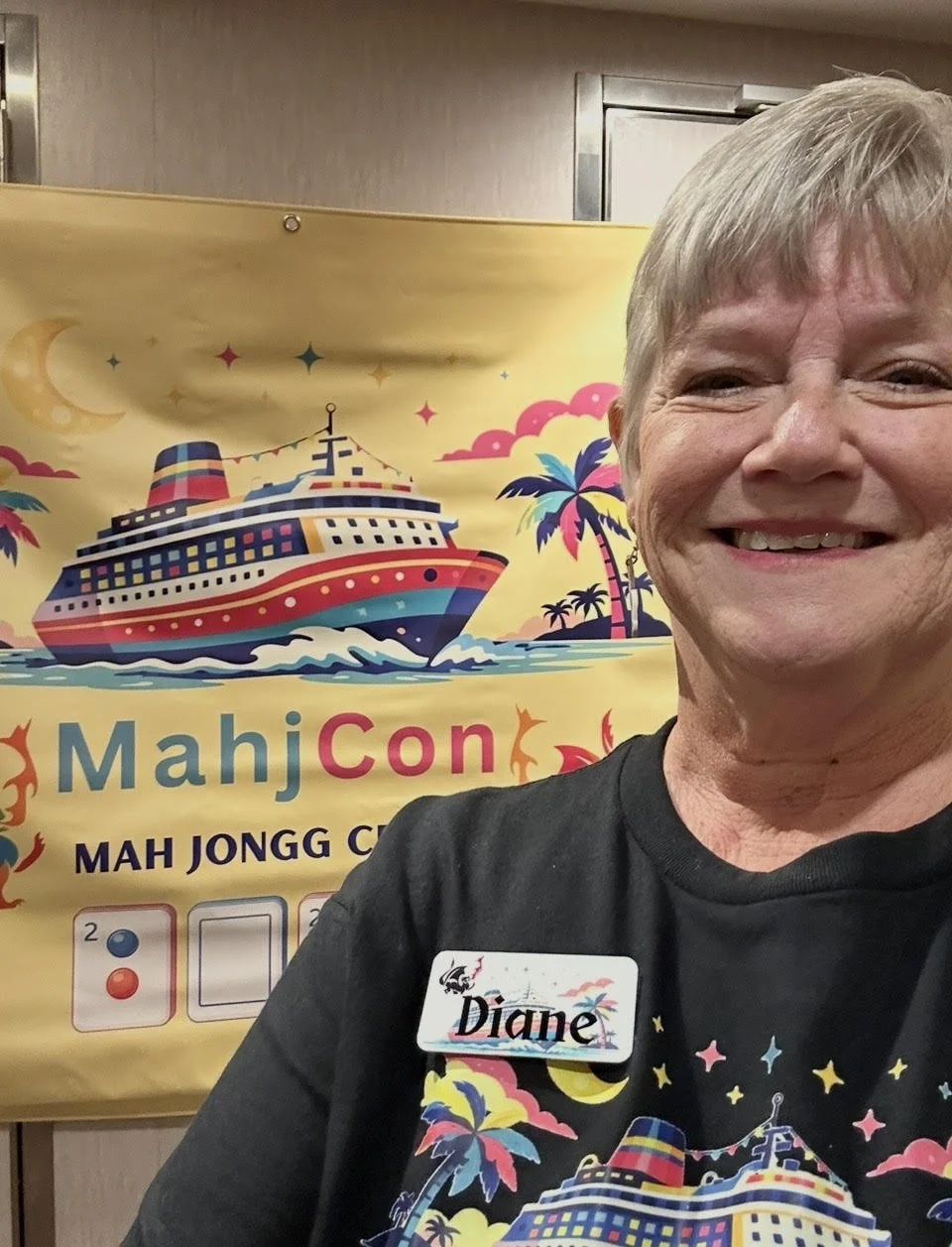
Diane at Mahj Con Cruise
I began teaching in 2024, friends and friends of friends. I’ve been referred to a few Sr Centers and Assisted Living facilities; these teaching experiences have been very rewarding. I have recently taught several groups (6-12 people), students find me in Facebook Groups, so many people want to learn. I mix volunteer teaching and paid for sessions, I’ve been complimented for my patience and fun/off the cuff scenario reflection.
Stacey: What motivated you to learn how to play, and can you talk a little bit about that experience?
Diane: I was a new mom in 1990, I’d never heard of Mahjong. A friend I met (her husband and mine were childhood best friends) asked if I wanted to learn, and her mother taught us. I learned with my friend, her sister and 3 of her neighbors. We played 2 Friday nights per month for several years.
Stacey:Will you say a little bit about your experience as a teacher of MJ? For example, do you have certain teaching methods and tools that you have found work best with newbies to the game?
Diane: One-on-one/one-on-two student teaching is easy, about 4 hours and we move along with basics and strategies. Group teaching is very involved; I meet with the group 3 times within a 2-week period. 1 three-hour session followed by 2 two-hour sessions. I introduce the game verbally, referring to my flipbook as I go. Students touch tiles and organize by suit, flowers, dragons, winds and jokers - it’s all about recognizing tiles at this point. We then assemble the walls, roll for East, tile distribution and begin game play. Students double or triple up, I use 1 set for at least 2 games. I coach each hand thru the ROLLOR Charleston and with each wall pick / discard claim. I remain neutral and beginner 4 players/teams complete 1 game in about 75 minutes. I explain as practice moves forward their game will be a slower pace and when they can play a game in 20 minutes it is appropriate for them to join a local group for social play. I encourage them to practice often, together and on their own. Playing with the tiles, building hands, studying the National Rules. I touch on house rules, but teach only National.
Stacey: What do you find is the most rewarding aspect of playing Mah Jongg? And same question, but for teaching the game.
Diane: Using my brain and coming close to a mahjong win is very rewarding. I often tell myself and others that even 1 or 2 away is terrific, not mahjong, per se, but a win in my mind. A wall game is also a win, because it indicates that all players played strategically, YAY! Mahjong is terrific brain work; the strategic thinking is a great reward.
Stacey: How do your students find you? And do you charge? If so, what is your typical fee?
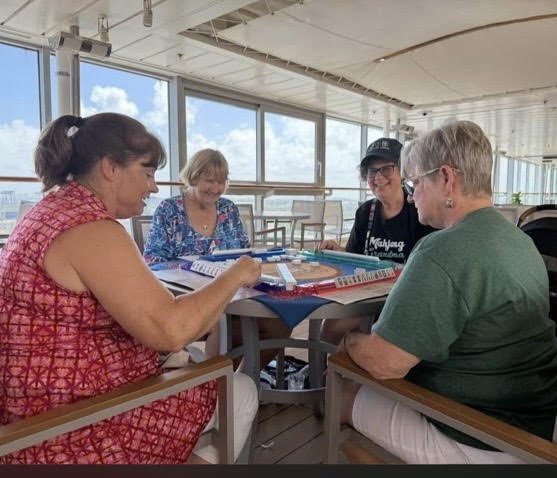
Mahj Aboard Ship
Diane: I charge an hourly rate (approx. $40) or a per student fee (3 sessions/7 hours of instruction) (recently $55 per person). If lessons are at the student’s location, then charge a travel fee per mile after the first 15 miles from my home, and I always offer to teach at my home. The hourly rate is payable per session, the per person rate is collected day 1 (no refund if a student drops out). If a large group (10-12) I sometimes employ an experienced player to join us and help, I pay that person by the hour.
Stacey: How did you first learn about my Flipbook? And, what do you think about the new, expanded third edition?
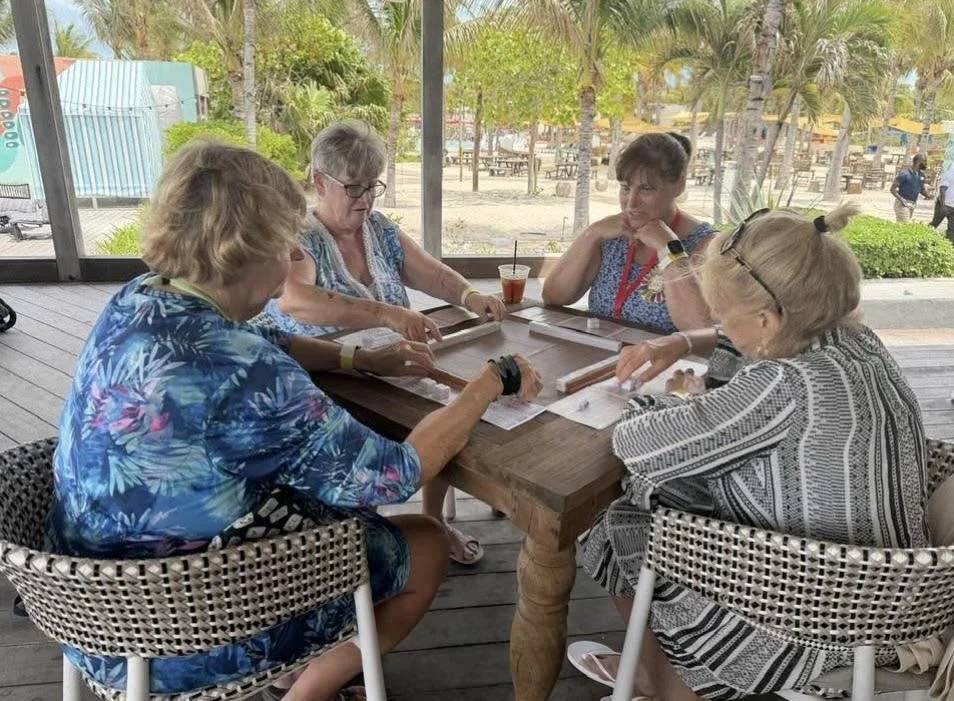
Game on Beach Excursion Day
Diane: I saw the flip book on Amazon a few years ago. I like it so much I use it as my teaching tool and recommend it often. I’m pleased to see the 3rd edition has some new areas covered. Charleston Decision Tree and Accessories & Resources are my favorite additions. Easy to follow. The Charleston Decision Tree is a valuable teaching tool and reference for newer players to determine their hand direction. Covering the scenarios visually with explanation allows new players to keep their hand in perspective. The Accessories and Resources section is similar to one-stop shopping. Scanning the QR codes is so easy, just scan, shop, and receive!
Stacey: Diane, it’s always gratifying to hear how Mahj teachers use my Flipbook, and thanks for telling us what you most appreciate about the new third edition. Switching gears now, do you have any experience playing Asian versions of Mah Jongg? If so, can you tell us which ones and how they compare with the NMJL's version of American Mah Jongg?
Diane: I have played Asian a few times over the years. I enjoyed the experience and it was fun to see the differences. I enjoy the challenge of playing with the card; thus, I play primarily American.
Stacey: I see.Are you familiar with Siamese MJ? How about Royal Siamese MJ? If so, how do you like playing that way? (If not, I recommend checking it out! I have a QR code in the 3rd edition of the Flipbook that takes you to the website for more info.)
Diane: I am familiar with Siamese, not Royal Siamese. I play Siamese if needed, not my preferred game. East takes 28, 2nd player 27. East discards then play continues from a messy tile set up in the middle. A player needs 2 Mahjongs to win, once a hand is exposed those jokers are dead, not available for exchange. Fun, if limited players.
Stacey: Do you ever play for money? If so, how do you feel about playing that way?
Diane: I play for money in each group I participate in. I feel rewarded when I have a good day. I track my up/downs in a register. Once a year I balance my coin bag and make a bank deposit. I average $250 winning in 12 months.
Stacey: Wow, that’s truly impressive! Moving on, have you attended or run any MJ tournaments? If so, will you say more about those experiences?
Diane: I attend many, along with mahj weekends and cruises. I have not organized a tournament. I enjoy fast, quiet competitive play. If you see Mahj as a social day out (lots of table chatter) a tournament is not for you, quiet fast play is key.
Stacey:Good point! What advice do you have for experienced players who are thinking of becoming MJ teachers?
Diane: Develop your personal style, pinpoint your personal comfort level of teaching (number of students at one time), move forward with teaching. Adjust when needed, be ready to pivot instruction if the group isn’t following, keep fluid and teach according to the students present. No one group is exactly the same. Do not be upset if students drop out, it’s not for everyone.
Stacey:Wise words indeed. What else would you like to say about your experience as a player or as a teacher of Mah Jongg that you think would be interesting, entertaining or educational to my readers?
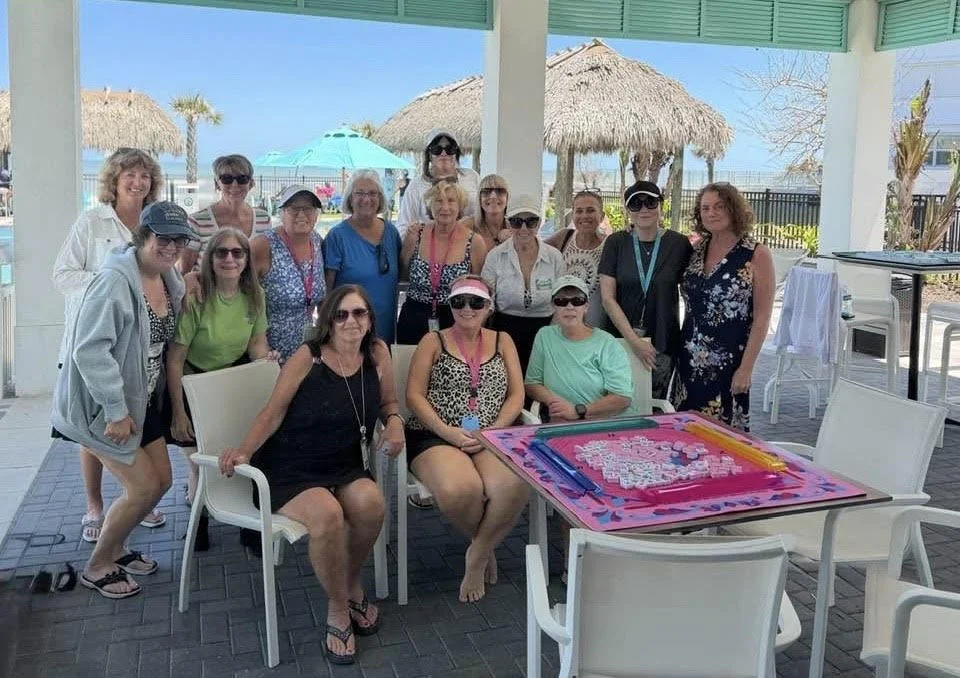
HOA Beach Play Date
Diane: Flexibility is key in both playing and instructing. Pivot, fluid mindset is important as both player and teacher. Do not be discouraged, I believe 1 or 2 tiles away is great playing, not winning, but, oh, so close! Keep the table chatter to a minimum, no drinks or snacks at the table. I do not invest in multiple sets or expensive tiles, mats, etc. Purchase your annual card only from the National League. I require my students to have the official card prior to the first lesson; I do not provide photocopies. It’s an under $20 investment and copywritten, don’t cheat the League.
Stacey:Thanks for sharing a bit of your background as a Mahj player and teacher, Diane. Your tips for teachers are especially valuable. As for newbies to the game, now those readers who are in or near Volusia County, Florida will be referring their friends to you for Mah Jongg lessons. May the Joker Fairy Smile Upon You!
Diane: Thank you for inviting me to participate in your Mahj Teacher Interview series on your blog, I am honored. I am available as needed for playing and instructing in Volusia County, FL and the greater Orlando area. Anyone interested can email me at dmt8562@yahoo.com. I hope to bring the Joker Fairy to all my games and sessions!
