Meet Iris, Another "Tile-riffic" Teacher of Mah Jongg
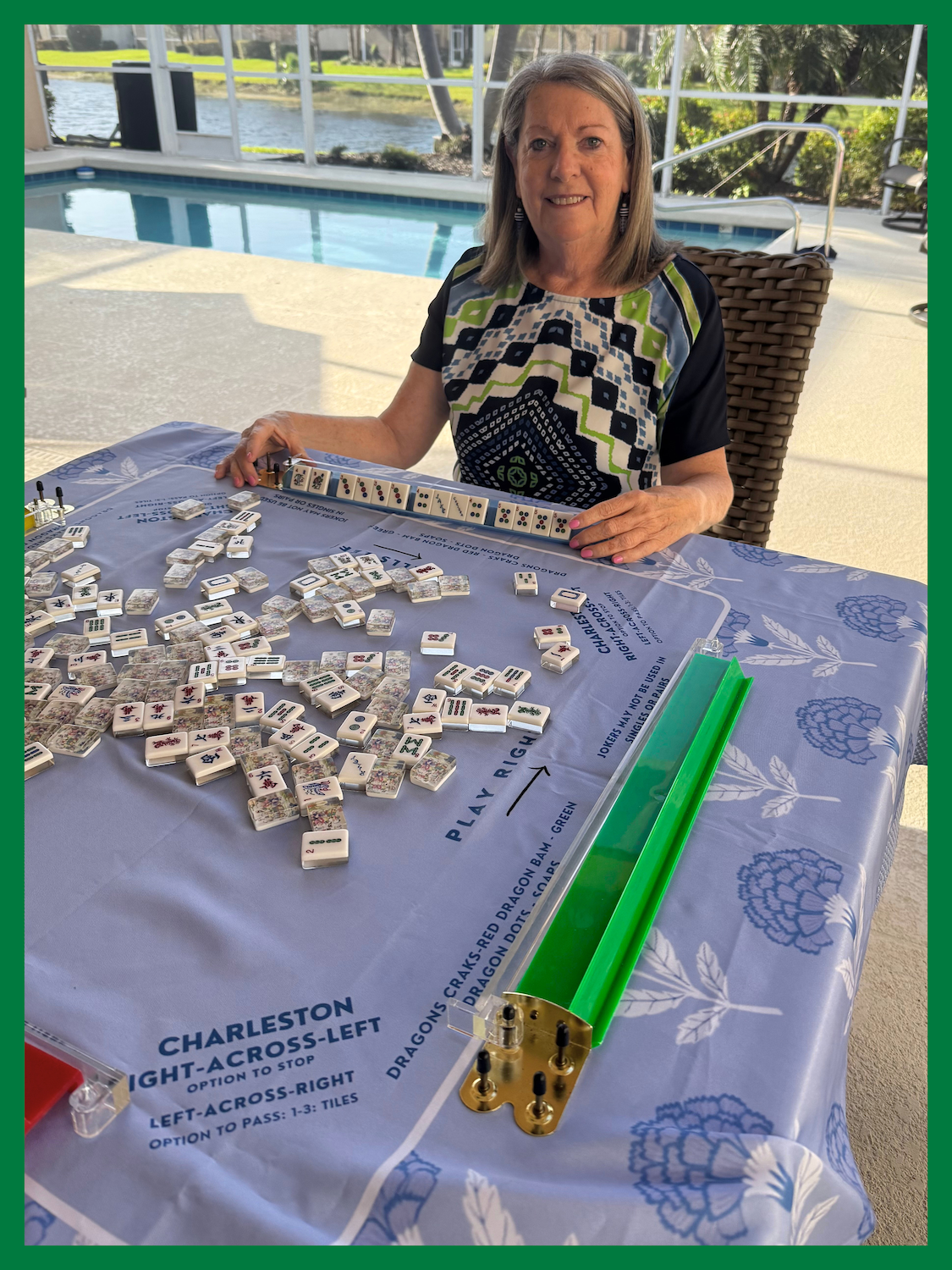
Introducing, Iris
Iris, a bi-coastal American Mah Jongg instructor who splits her year teaching eager students across Florida and Maryland, is injecting fresh joy into the American MJ community through creative celebration. Known for her infectious enthusiasm, Iris has found a clever way to immortalize that unforgettable milestone: a player's very first mahj win. To capture the triumph, she designed vibrant, pun-filled photo props for her students to proudly hold up, ranging from witty puns like "Bam-tastic Play!" and "Tile-riffic Strategy!" to ultimate badges of honor like "Dragon slayer!" and "Mah Jongg Queen!" In this interview, we chat with the traveling teacher to discuss her unique teaching journey, her sound advice for those who love teaching the game, and her top tips for beginners looking to shout "Mahj!" for the very first time.
Stacey: Thank you, Iris, for agreeing to share your Mah Jongg teaching expertise with my readers. Let’s start with some background. Can you tell me how long you've been playing American Mah Jongg? And how long have you been teaching others how to play?
Iris: I started playing about 23 years ago and I have been teaching for about 15 years.
Stacey: And where do you currently teach?
Iris: I teach in Baltimore, MD half of the year: May – October and then I am in Sarasota, FL the other half: November – April.
Stacey: Let’s get into what motivated you to learn how to play over 20 years ago, and can you talk a little bit about that experience?
Iris: One of my friends said she wanted to learn how to play MJ and asked me if I was interested as well. She had other friends who played and they were willing to teach us. It was around the time that our children were in college and we felt like we didn’t have to be home or around for the kids. And it was a great way to have a reason to socialize with some girlfriends.
Stacey: Will you say a little bit about your experience as a teacher of MJ? For example, do you have certain teaching methods and tools that you have found work best with newbies to the game?
Iris: I have a pretty specific format that I follow: First I identify the tiles and have the students separate the tiles by suits, winds, flowers and jokers. Then I introduce the card and go through each section and explain all the parts of the card: the colors, the values, closed vs exposure, etc. Finally, during the first lesson, I have strips of paper with a specific hand on each strip. I have the students match the tiles to that hand. If we have time, then we start to “play” with much guidance, obviously. I also give quizzes at the next lessons. People really seem to like that and it helps them remember certain rules.
Stacey: What do you find is the most rewarding aspect of playing Mah Jongg? And same question, but for teaching the game.
Iris: Most rewarding aspect of playing: the challenge of getting THAT Mah Jongg and playing with friends. Most rewarding aspect of teaching: watching the students “getting it.” I really get a high when they get a Mah Jongg and watching their faces when they succeed.
Stacey: How do your students find you? And can you describe the typical number of lessons your students take with you, and if you do one-on-one or small or larger groups at one time? And do you charge? If so, what is your typical fee?
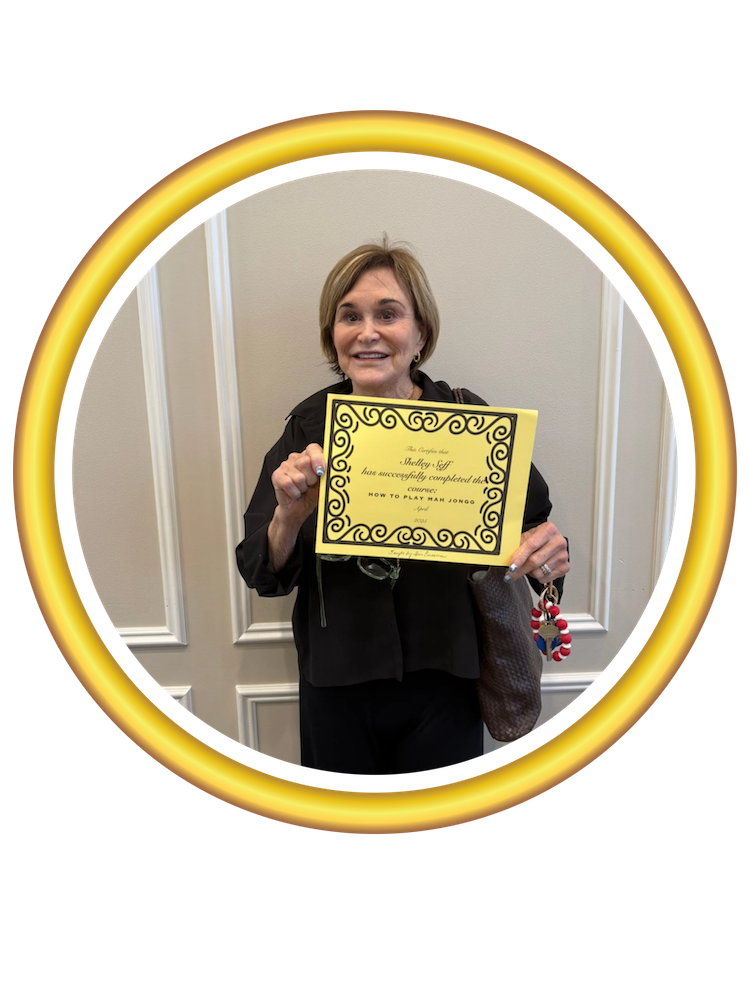
A Proud Student Showing Off her Class Completion Certificate
Iris: I am on a list of a bunch of different websites that list teachers. That’s where I usually get students. When I first began “professionally” teaching (not just for friends) and getting paid to do so, it was through a school’s adult outreach program. So that school advertised the class in their course book. I have started using social media but I am really not good at that. (As an aside, my daughter is also teaching Mah Jongg - in addition to her “regular” job as a school teacher. For the last year, she has gotten SOOOO many jobs. AND it’s all been word of mouth. Her name is spreading around our community like wild fire!)
I like to do 4 two-hour lessons. When I taught the class from the adult outreach program, it was a 6-week course. We charged for that class and the school and I each got a percentage from the charge. As far the number of students...... it just depends. I have taught one student and have taught up to 10 students and everything in between. It all depends on who is asking. I am very flexible in terms of number of students, time of day and location. I have taught lessons at my home, the students’ homes, the clubhouse in my community, etc. I do charge. I was charging $20 per person per hour. I have “upped” it to $25. And I have also started charging as a package: $200 paid in advance for 4 lessons that includes handouts and a certain instructional flip book (hummmm, I wonder which one that is - haha!). IF they want more, that they can pay for each additional lesson. Having said that, I really take each request as it comes in and will modify it and personalize it to fit the needs of the students. The reason why I starting charging as a package is this: What I found is that, for example, 5 ladies will request lessons. Then the next lesson, only 3 show up, or something like that. With paying in advance, the students are more committed to showing up.
Stacey: Speaking of my Flipbook, how did you first learn about it? And, have you had a chance to look over the new, expanded third edition yet? If so, do you have any feedback for me?
Iris: I honestly don’t remember how I first learned about your book. FEEDBACK on the 2026 edition of your FLIP BOOK.
+ Love the bright colors
+page 4: JOKERS, last item: Only during your turn can you exchange the joker with the tile that the Joker replaces. Also, I tell my students to ask politely for the joker and hand over the required tile - rather than just taking the tile off of the other player’s rack.
Stacey: Good point!
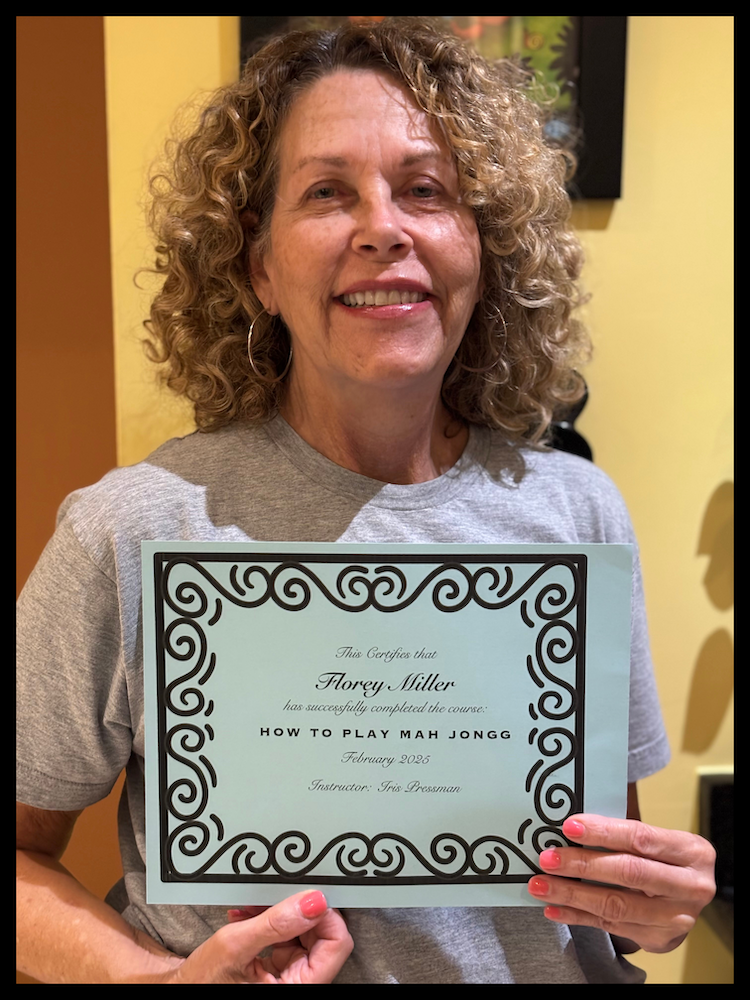
Another Student of Iris's Who Earned a Class Completion Certificate
Iris: +page 5: I didn’t know about the “new” rule about either using 1 or 2 dice to roll to determine who is East
+page 13: Should this be added? When you call for a tile, you must put it on the top of the rack and not on the slope.
Stacey: I think you are asking if it is okay for a player who has called a discarded tile to place it in her rack and then expose it along with the entire set of tiles it goes with on top of her rack. I couldn’t find this specific rule when calling a tile in the NMJL’s official rule book. But I did find that Tom Sloper addresses this issue on his website, here: https://www.sloperama.com/mjfaq/mjfaq19.html#k. Under part K: The 2023 newsletter states that the taken discard must be placed atop the rack, not among the concealed tiles. But the League says there is no penalty for putting the claimed discard in the hand before placing it on the rack. The upshot of the rule is, "you're not supposed to do that." It's frowned on, but there's no penalty.
Speaking of racking your tile, this is a bit “into the weeds”, here, but I feel it is important to say that when it’s your turn to draw a tile from the wall, you don’t have to rack it. It’s perfectly okay to draw it, look at it and discard it without even putting it near your rack. That being said, a good habit to establish early with newbies is to have them automatically rack their tiles (not “tap”) in order to close the opportunity for other players to call the tile that was just discarded by the previous player. But that opportunity window also closes when they discard their tile. Unfortunately, with limited space in my Flipbook, it was not possible for me to list all the various situations that come up in the game. This is why I love using Sloperama as a reference when questions about the finer aspects of the game come up.
Iris: That’s a good point. I would like to add that there is an app called Mahjpedia, that I consult for further explanation on some of the rules when I need clarification. Have you heard of it?
Stacey: No, that’s a new one for me. I’ll check it out, thanks!
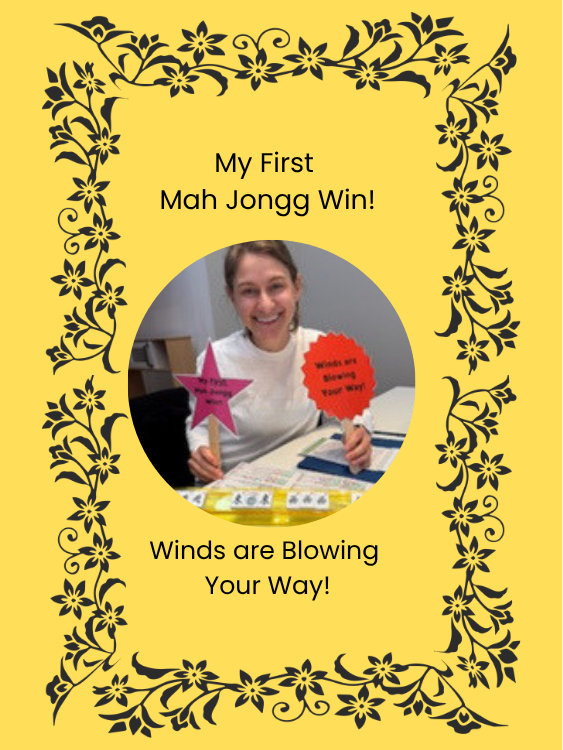
Two of the Fun Photo Props Iris Designed
Iris: Here’s another question: This came up in a lesson. When a tile is thrown, and someone says WAIT, can another player say, “I want it” or call for that tile? Or do you have to wait for that person who said “wait” to decide if she wants it or not?
Stacey: On page 18 of the NMJL’s official rule book it says: “If two players call for the same tile, the player next in turn to the discarder has preference except when other caller has exposed tiles(.)” I address this recent change in the rules in my Flipbook on p. 13. I said that this rule promotes un-sportsperson-like behavior, and so the groups I play with prefer to stick to the old rule where when 2 (or 3) players call for the same discard, the tile always goes to the player whose turn is next (unless the other caller wants the discarded tile for Mah Jongg, of course, and if two people want it for MJ, then the player whose turn is next gets it).
Moving on, do you have any experience playing Asian versions of Mah Jongg? If so, can you tell me which ones and how they compare with the NMJL's version of American Mah Jongg? If not, do you have any interest in learning?
Iris: I have never played any other versions of Mah Jongg. But if one of my friends offered take me along with them to learn an Asian version of Mah Jongg together, I would definitely be open to that.
Stacey: Last year I was offered the opportunity to learn Taiwanese Mahjong and I found it really fun. I like to play it when I don’t feel like thinking too hard. It’s a simpler game where you are just making sets and runs because there is no card. So, it’s more like the card game, rummy. Speaking of different versions of Mah Jongg, are you familiar with Siamese MJ? How about Royal Siamese MJ? If so, how do you like playing that way? (If not, I recommend checking it out! I have a QR code in the 3rd edition of the Flipbook that takes you to the website for more info.)
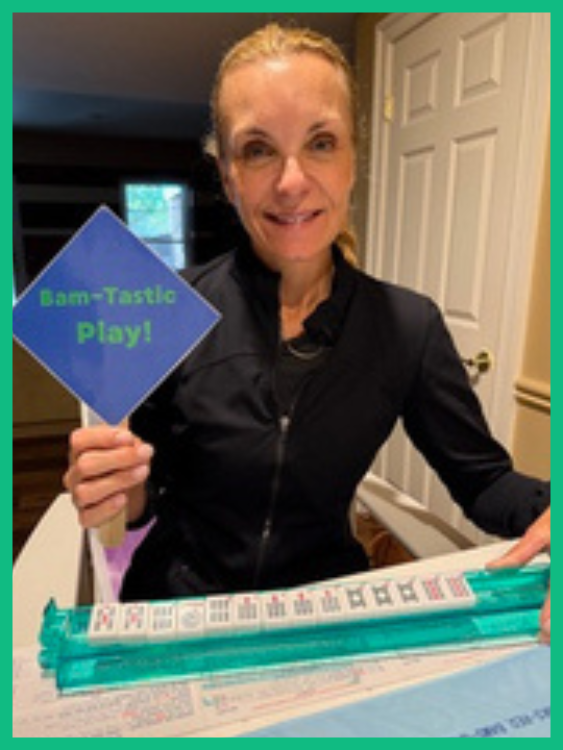
Bam-Tastic Play!
Iris: I have played Siamese MJ but not royal Siamese yet. I like playing it and it really taxes the brain!!!
Stacey: Do you ever play for money? If so, how do you feel about playing that way?
Iris: I do play for money but only with a $5 pie. My neighbor plays with $10 and $20 pies and I don’t want to play with her. It’s not worth it to potentially lose that much money. And if people don’t want to play for money, that’s OK too, I don’t mind that.
Stacey: Have you attended or run any MJ tournaments? If so, will you say more about those experiences?
Iris: I have attended 2 tournaments. I did not enjoy them. The people there were too intense. And I found some to not be kind. Life’s too short for me to be stressed out and not enjoy playing.
Stacey: I feel the same way about playing in tournaments. Let’s talk a bit more about teaching MJ now. What advice do you have for experienced players who are thinking of becoming MJ teachers?
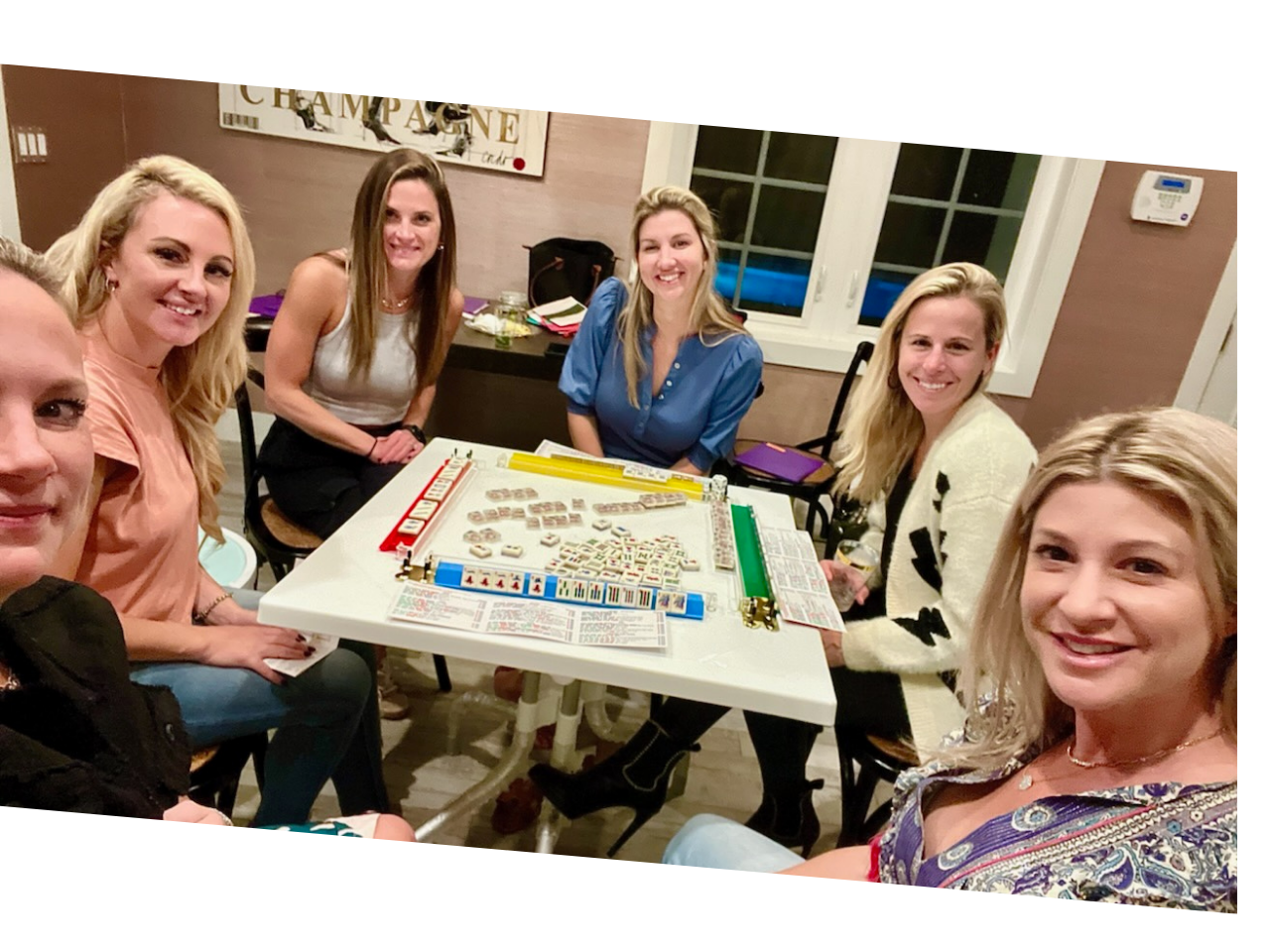
Six Newbies Having Fun Learning Mah Jongg
Iris: I would definitely advise them to have a plan, similar to the one I described in an earlier question. And I would recommend that they be patient with the students. The students will ask a lot of questions at the beginning.
Stacey: What else would you like to say about your experience as a player or as a teacher of Mah Jongg that you think would be interesting, entertaining or educational to my readers?
Iris: My one advice is that teachers should teach this game by the National Mah Jongg League rules. When I teach, I always tell the students what the rules are. Then if I tell them something other than the rule, I make sure they know if it a curtesy suggestion, i.e. putting a “tail” at the end of the wall that is being pushed out. That is not a rule but something that helps them remember which end to pick from. Another thing I emphasize is racking your tiles. That is not a rule either but I explain how that ends the last person’s turn and begins yours. (It drives me crazy when I see people “tapping” their tiles at the top of the racks and they think that takes the place of racking.
Stacey: I know what you mean. LOL! Thanks for sharing your MJ playing and teaching experience with us. I also want to express my gratitude to you for sharing photos of your Mah Jongg students holding the fun signs you made when they win for the first time! And the certificate you give them is a really nice touch.
Readers:
For those of you in her area who would like to discuss arranging lessons with Iris, she has kindly shared her contact info:
410-274-2437
Baltimore, MD May - October
Sarasota, FL November - April
Teaches beginners as well as strategy classes.
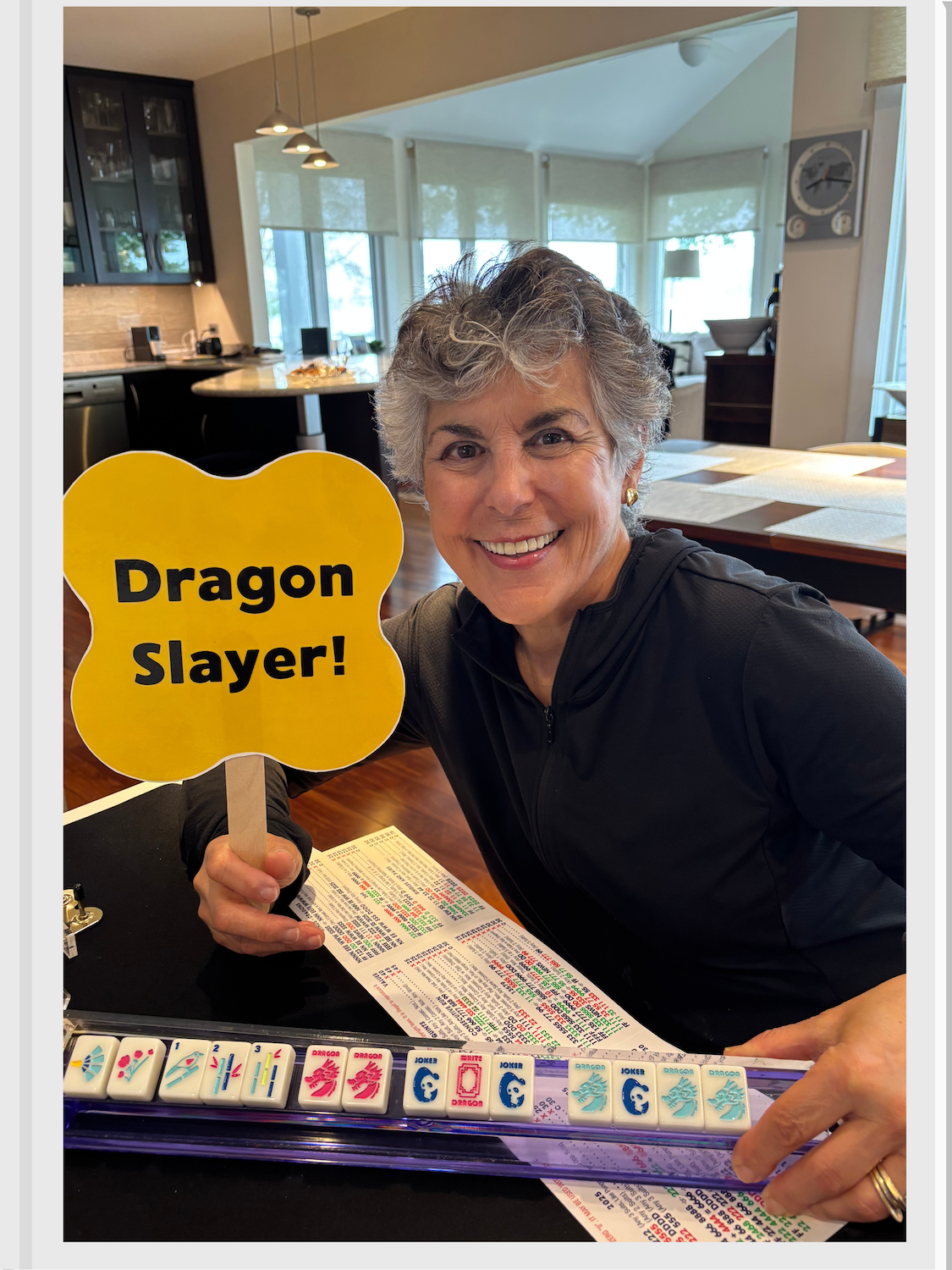
Bam-Tastic Signs Available for Download
BONUS OFFER: BAM-TASTIC SIGNS
If you like the signs Iris made and would like to get a PDF of them so you can make them at home for your MJ students, or if you know a MJ teacher who would like a set of them, then just fill out the form below to download. Iris has generously given me permission to send them to you. Here’s what each of the set of nine signs says:
Bam-Tastic Play!
Joker Jackpot!
Tile-riffic Strategy!
Winds are Blowing Your Way!
My First Mah Jongg Win!
Tile by Tile, You're on Fire!
Mahj-nificent Win!
Dragon Slayer!
Mah Jongg Queen