Mah Jongg: Back in Style 100 Years Later
Today’s blog entry grew out of something another Mah Jongg teacher told me. Her name is Shonda and she hails out of Arkansas. Shonda is one of the teachers I am interviewing as part of my series on interviews with MJ teachers across the country. Here is a little taste of what we talked about, and how our conversation sparked the idea for this current blog entry.
The learning resources that Shonda has her students use include my Flipbook, and I am gratified to know that she finds it an essential teaching tool. I also was drawn to her Mah Jongg origin story, a journey that began with her mom. More about their story in a later blog post. But it got me thinking about another topic, the popularity of Mah Jongg in the U.S. during the 1920s.
Shonda's mom, who has since passed away, never said exactly why learning American Mah Jongg first interested her. But Shonda likes to imagine her mom having come across columns about American Mah Jongg printed alongside the bridge columns still seen in some newspapers.
I wanted to look into this bit of history. Isn’t the internet an invaluable tool when one wants to go down a rabbit hole? I soon discovered an article published in 2020 on a website called genealogybank.com. Gena Philibert-Ortega wrote a fascinating piece titled, “Fun and Games in the Newspaper: Mah Jong.” Pictures included with her article are artifacts from the 1920s, straight out of newspapers from that time.
I reached out to Gena, who gave me permission to use her piece on my blog, and I'm glad to credit her and the GenealogyBank website. I am curating her article with some highlights:
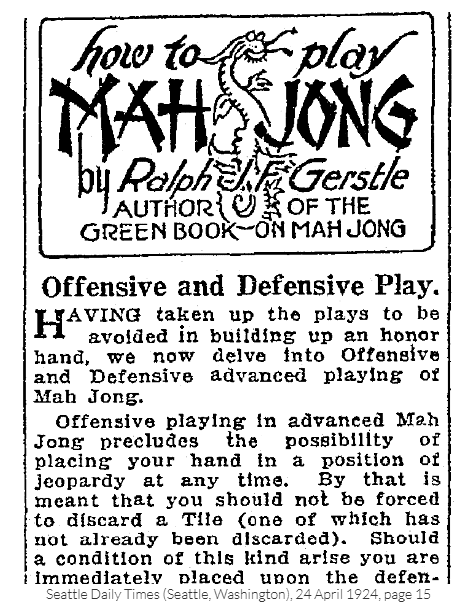
Besides giving us a brief history of the game in this country in its 1920s heyday, Gena says newspapers did much to spread the word about it. Two men were instrumental in taking Mah Jongg public. One was L.L. Harr, who helped popularize the game in England. The other was Ralph J. F. Gerstle, who had a column in the Seattle Daily Times called “How to Play Mah Jong.”
Gena tells us more, “In an introduction to these columns, the paper asked: Do you play Mah Jong? If you don’t, you will. More than 3,000,000 of the people of the United States are playing it …”
Wow, 3 million? I bet that could be said today, too, because there certainly is a resurgence of Mah Jongg across the country now. Many of us who’ve been playing for years have our own theories. I view it as a combination of people longing to get away from the cellphone screens in their purses or pockets, plus a desire to connect face-to-face with other like-minded players. For us older people, I imagine the social aspect of the game is a big draw, as well as the intellectual challenge of learning something new.
What is your guess as to why Mah Jongg has become so popular today? Feel free to share your thoughts with me by sending an email to flip4mahjongg@gmail.com.
If you have some other ideas you would like to share on my blog, even better! Send in some pics of you and your friends playing Mah Jongg, too. Readers' thoughts and experiences with Mah Jongg are welcome here, and I'll be pleased to pass along what I receive from those who feel moved to share them.
In the meantime, let’s go back to 1924 now . .
The photo below is from Gena’s piece, a snippet of an article by Mr. Gerstle that appeared in the April 24, 1924, issue of the Seattle Daily Times.
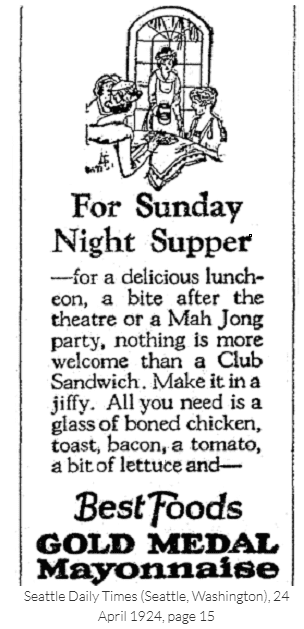
Gena’s favorite item in the newspaper from that era is an advertisement that highlights just how much of a fad Mah Jong became. Best Foods recommends their mayonnaise for club sandwiches for your Mah Jong party! Gena says, “A whole industry sprang up around playing Mah Jong that included the perfect food, accessories, and clothes to wear while hosting parties and playing the game.”
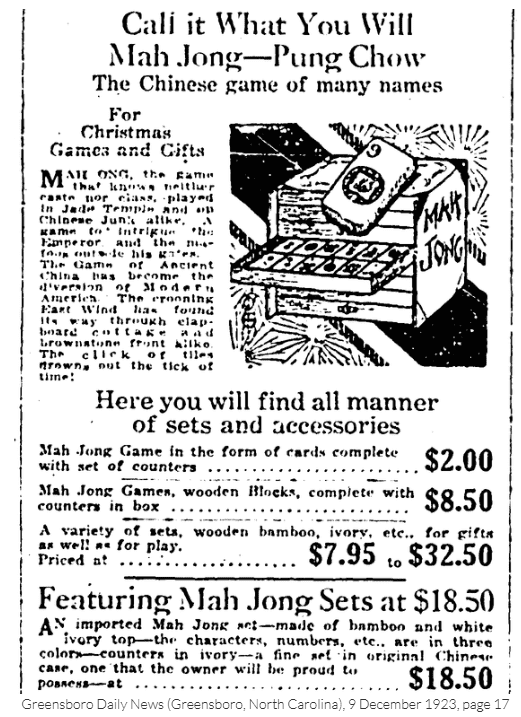
One more really interesting example from Gena’s research shows some holiday gift giving ideas for playing “The Chinese game of many names.” Look at that price tag for “wooden blocks” (I imagine what we call tiles these days) “complete with counters in a box . . .$8.50.” And a Mah Jong complete set for $18.50.
I hope you enjoyed this historical peek at Mah Jongg in the newspaper as much as I have. I encourage you to take a look at the original article by Gena because she has more newspaper artifacts there: https://www.genealogybank.com/blog/fun-and-games-in-the-newspaper-mah-jong.html